
Being in business is fun, but when it comes to managing your taxes, things can soon become very difficult for you. Regardless of whether you are starting out as a new business owner, running a small business, or expanding a business that already exists, tax planning and strategies can play an important role. The tax planning and strategies that we offer at Mukesh Thakur can be quite beneficial for you.
As an experienced business tax consultant , we believe tax planning should never be limited to filing returns once a year. Effective planning is an ongoing process that helps business owners make smarter financial decisions throughout the year. Our approach focuses on identifying opportunities, improving compliance, and creating strategies that support both short-term operations and long-term business growth.
In addition to strategic planning, we also provide professional tax filing assistance, ensuring your tax documents are prepared accurately, submitted on time, and aligned with current IRS requirements.
Most business owners usually think about taxes only when filing deadlines are near. However, this approach often prevents them from maximizing tax savings and building an effective long-term financial strategy. Proper tax planning requires businesses to evaluate financial decisions throughout the year rather than waiting until tax season.
A proactive tax strategy helps businesses legally reduce unnecessary tax expenses, improve cash flow, prepare for future growth, and identify potential financial risks before they become costly problems. It also supports better investment decisions while reducing the chances of receiving unnecessary IRS notices.
Year-round tax planning also encourages accurate recordkeeping, stronger budgeting, reliable forecasting, and better financial management. Every financial decision becomes part of a structured plan designed to support long-term business success.
At Mukesh Thakur, we help our clients understand how every financial decision impacts their overall tax position so they can make informed choices with confidence.
We provide customized tax planning solutions designed to help businesses remain compliant while improving overall financial performance.
Tax planning should begin long before tax returns are filed. Our annual tax planning service reviews your income, expenses, deductions, payroll, business structure, and future goals to develop a customized strategy for the upcoming financial year.
Regular planning allows businesses to prepare for estimated tax payments, maximize available deductions, and avoid unexpected tax liabilities.
Every business has opportunities to legally reduce its tax burden through proper planning. We work closely with business owners to evaluate operations, transactions, and financial activities to develop practical tax-saving strategies that align with business objectives.
Our strategies may include:
Income tax planning is essential for business owners, freelancers, entrepreneurs, and professionals. We evaluate taxable income, deductions, tax credits, estimated taxes, and reporting requirements to create a practical tax strategy.
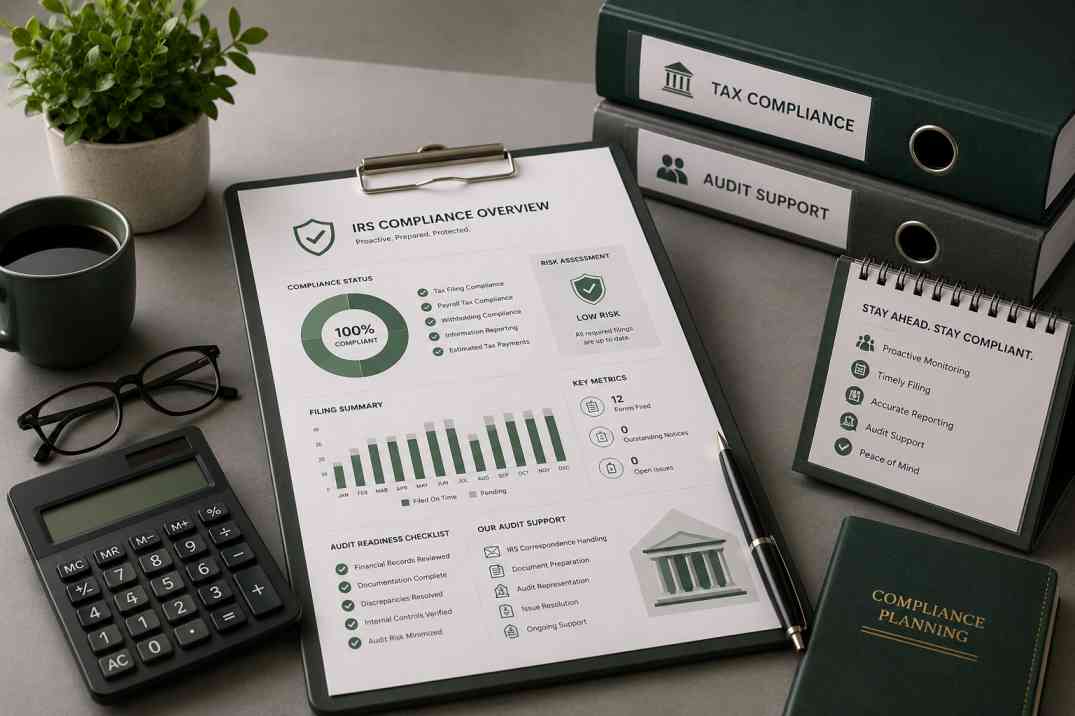
Our tax filing assistance ensures your federal and state tax returns are prepared accurately while minimizing common filing mistakes.
Planning for retirement involves understanding both financial growth and future tax obligations. We help clients explore tax-efficient retirement planning strategies using retirement accounts while considering future income and withdrawal requirements.
Proper retirement tax planning allows business owners to build wealth while reducing unnecessary tax burdens over time.
Investment activities lead to tax liabilities as well. Our investment tax planning services will allow you to learn more about the tax consequences of capital gains, dividends, income from investments, and sales of property.
Proper investment planning allows making effective financial decisions.
Preparing tax returns requires attention to detail, accurate financial records, and knowledge of changing tax regulations.
Our professional tax filing assistance includes:
We focus on accuracy, compliance, and timely submissions to help businesses avoid penalties and unnecessary stress.
Modern tax planning depends on reliable accounting and tax software. At Mukesh Thakur, we work with industry-recognized tools that improve accuracy, reporting, and financial management.
These platforms help businesses manage bookkeeping, invoices, expenses, payroll records, bank reconciliation, and financial reporting.
Professional tax preparation often involves advanced software such as:
These tools assist in preparing tax returns, calculating tax liabilities, reviewing deductions, and maintaining compliance with IRS requirements.
Payroll taxes are an important part of business compliance. Common payroll platforms include:
These systems simplify payroll processing, tax withholding, employee benefits, and payroll tax reporting.
To improve collaboration and document management, businesses commonly use:
These tools help organize tax records, financial statements, contracts, invoices, and supporting documentation.
Business owners often come across a wide range of tax and accounting terms while managing their financial responsibilities. Understanding these concepts is essential for making informed decisions, maintaining compliance, and communicating effectively with tax professionals.
Terms like IRS compliance, tax deductions, tax credits, business expenses, payroll tax, sales tax, federal tax, state tax, self-employment tax, and estimated tax payments are commonly used when discussing business taxation and financial obligations. Similarly, capital gains tax and tax liability play an important role in understanding how income and investments are taxed.
From an accounting perspective, concepts such as bookkeeping, financial statements, profit and loss statements, balance sheets, and cash flow statements help business owners track performance and maintain accurate financial records. These reports are essential for evaluating business health and planning future growth.
In addition, businesses frequently work with identification numbers and tax forms such as EIN (Employer Identification Number), W-2, W-9, Form 1099, Form 1040, Form 1120, Form 1065, Schedule C, and Schedule E. Each of these plays a specific role in reporting income, managing payroll, or filing business and individual tax returns.
A clear understanding of these terms allows business owners to navigate the tax system more confidently and ensures smoother collaboration with tax advisors and financial professionals.